
Cost of Living in Dubai: An Honest Expat Breakdown
An independent breakdown of the true cost of living in Dubai, including verified data on rent, transport, and healthcare regulations.

Dubai is frequently ranked as one of the more expensive cities in the Middle East, yet it remains highly attractive to expatriates due to its tax-free salaries. Evaluating a job offer requires accurately estimating the local cost of living to determine how far your income will actually stretch.
This guide breaks down the major expenditure categories based on official pricing structures and verified market averages.
Housing and Rent
Accommodation is typically the largest single expense for expatriates. Historically, landlords in Dubai required a full year’s rent upfront in a single cheque. While the market has softened to commonly accept between four and twelve cheques (or direct debit mandates), you must still budget for significant upfront costs, including a 5% security deposit and a standard 5% agency fee.
Rental prices vary dramatically based on location. According to the official Dubai Land Department (DLD) Rental Index, broad estimates for a standard one-bedroom apartment in 2024 include:
- Premium Locations (Downtown Dubai, Dubai Marina): AED 80,000 - 140,000 per year
- Mid-Tier Locations (Jumeirah Village Circle, Al Barsha): AED 50,000 - 75,000 per year
- Suburban/Value Locations (Dubai Silicon Oasis, International City): AED 35,000 - 50,000 per year
Transportation

Dubai is a car-centric city, though the Roads and Transport Authority (RTA) operates a comprehensive public transport network (Metro, Tram, and Bus) utilizing the Nol card system.
- Public Transport: According to the RTA, a single Metro journey costs between AED 3.00 and AED 7.50, depending on the number of zones crossed. A monthly unlimited standard Nol pass costs AED 350.
- Driving: Petrol prices in the UAE are regulated and adjusted monthly by the Ministry of Energy. Driving costs also include mandatory annual vehicle registration, insurance, and Salik (toll gate) charges of AED 4 per crossing.
Healthcare Insurance Regulations
Under Dubai Health Authority (DHA) Law No. 11 of 2013, it is mandatory for employers to provide health insurance for their employees in Dubai.
Importantly, while employers must insure their employees, the law does not legally mandate Dubai employers to pay for the insurance of the employee's dependents (spouse and children), although many large multinationals choose to do so as a perk. If you must insure your family privately, basic packages start at approximately AED 4,000 per year per dependent.
Education
Expatriate children must attend private schools. The Knowledge and Human Development Authority (KHDA) regulates school fees, which vary based on the curriculum (British, American, IB, or Indian) and the school's official KHDA rating.
As a broad estimate from KHDA fee structures, annual tuition for a British curriculum school ranges from AED 30,000 to over AED 90,000 per child, excluding transportation and uniforms.
Illustrative Budget (Estimate Only)
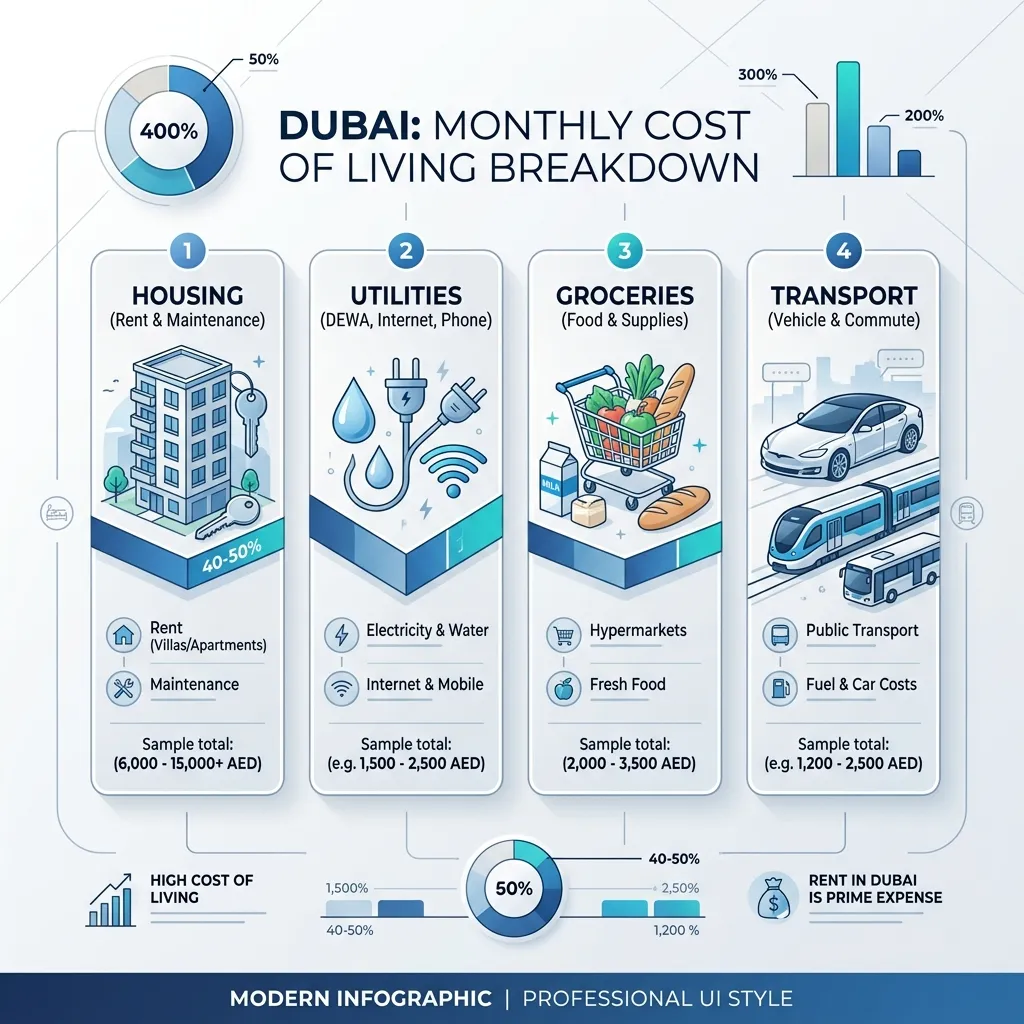
Cost of living is highly subjective. A single professional sharing an apartment in a mid-tier area, utilizing public transport, and managing discretionary spending might live comfortably on a budget of AED 10,000 to AED 14,000 per month. Note: This is an illustrative estimate based on a modest lifestyle, not an official market average. A family of four requiring a villa, two cars, and private schooling will require a significantly higher income to maintain the same standard of living.
Sources and References
- Dubai Land Department (DLD): Official Rental Index (Reference for standard rent ranges by zone).
- Roads and Transport Authority (RTA): Nol Card Fares (Reference for the AED 3.00 to AED 7.50 transit pricing).
- UAE Government Portal: Health Insurance Laws (Confirming DHA Law No. 11 of 2013 and that Dubai employers are only mandated to cover the employee, not dependents).
- Knowledge and Human Development Authority (KHDA): School Fees.